
LiftMaster Welding & Fabrication: The New York City Owner’s Guide
LiftMaster gate welding and fabrication repairs in New York City typically run $340-$780 installed, depending on gate size and material, and we stock common LiftMaster-compatible brackets, hinge assemblies, and track sections for same-day completion. Most homeowners notice the problem when their gate opener strains, stalls, or throws an error code while the gate itself drags or binds. Ironworks Gate Co. carries fabricated replacement components for LiftMaster’s residential and light-commercial lines, and we match the part to your model before we leave the shop.
We’ve been called to jobs in Queens where a homeowner watched their sliding gate chew through a misaligned bracket for three weeks before the motor finally quit. By then the weld had cracked through, the track was egg-shaped, and the repair cost twice what it would have. A gate that works quietly is a gate that’s been done right.
Which LiftMaster Models This Applies To
LiftMaster gate automation breaks into three families, and the welding and fabrication parts differ across each. The SL3000 and CSL24V series are the heavy-duty slide and swing operators you’ll see on commercial properties and larger estate driveways in Riverdale or the North Shore of Staten Island. These use 1/4-inch and 3/8-inch steel mounting brackets, custom-fabricated catch posts, and reinforced hinge plates that take the gate’s full cantilever load. The LA400 and LA500 residential swing gate openers are lighter but no less particular: their actuator mounting geometry is exact to the inch, and a bracket welded even slightly out of square will bind the arm within a season.
The RSL12V and EL25 residential slide operators are common on tight New York City lots in Bay Ridge and Forest Hills, where the gate slides on a track mounted to a retaining wall or fence line. Here the fabrication challenge is often the track itself: LiftMaster specifies a flatness tolerance that generic angle iron won’t meet. We stock OEM-compatible track sections and custom-fabricate wall-mounted brackets to match the masonry or wood structure we’re attaching to.
Your model number lives on a silver label on the motor housing. The serial prefix tells us the series, and from there we pull the fabrication specs: bracket hole pattern, actuator stroke length, track gauge, and weldment grade. We also carry quality aftermarket equivalents where the OEM bracket is back-ordered or discontinued. For most New York City residential jobs, the aftermarket part meets the same ASTM specification and carries our 90-Day Done Right Promise. On commercial jobs with NYC Department of Buildings oversight, we typically specify OEM to keep the permit path clean.
Signs Your LiftMaster Welding & Fabrication Is Failing
- The opener runs but the gate barely moves or stalls mid-cycle. This usually means a cracked weld on the drive bracket or a bent track section is adding mechanical resistance the motor wasn’t sized for. The opener’s internal force sensor trips, and the board shuts it down to protect itself.
- You hear metal grinding or popping when the gate starts or stops. The hinge pin weldment or catch post has shifted or cracked, letting the gate rack against the frame. In New York City’s freeze-thaw cycles, water gets behind a poorly sealed weld and pops it within two or three winters.
- The gate hangs crooked or drags at one corner. A failed diagonal brace, cracked jamb weld, or sagging track support is letting gravity win. On older iron gates in Brooklyn and the Bronx, we’ve seen this where the original 1970s weld was done with rod that doesn’t match the base metal.
- Intermittent operation that clears up if you push the gate by hand. The limit switches are fine, the board is fine, but a binding track or misaligned bracket is throwing enough resistance that the motor thinks it has hit an obstacle. The safety reverse kicks in, and you’re left standing in the driveway.
- Visible rust streaks below any welded joint. This is early warning. The weld bead or heat-affected zone has lost its coating, moisture is wicking in, and the joint is eating itself from the inside. Caught early, we grind, weld, and re-coat before the bracket is scrap.
Replacement Cost & What’s Included
| Service | Typical Range in New York City |
|---|---|
| Single bracket / hinge weldment replacement | $340 - $480 |
| Track section fabrication and install | $520 - $680 |
| Full gate frame repair (multiple weldments) | $680 - $780 |
| Emergency call-out, nights or weekends | Add $120 - $180 |
These are installed prices, parts and labor together, with no add-ons after we quote. What drives the range: gate material (aluminum welds faster than wrought iron), access (a sunken driveway in Manhattan Beach versus open frontage in Bayside), and whether the original fabrication was done to standard or needs complete rebuild. Every job gets a written quote before we strike an arc. The 90-Day Done Right Promise covers the weldment, the fit, and the finish. If a crack shows or a bolt loosens, we come back and make it right, no paperwork, no arguing.
Active offers: $50 off any repair over $250; free second opinion on any written estimate you’ve already received; $89 seasonal tune-up to catch this before it fails; and a permanent 5% senior and veteran discount.
DIY or Call Us?
There’s a short list of things a homeowner can safely check. Verify the gate moves freely by hand with the opener disconnected. Look for obvious cracks in visible welds, loose bolts, or debris in the track. Check that the stop plate hasn’t been pushed out of position. That’s about where DIY ends for this work.
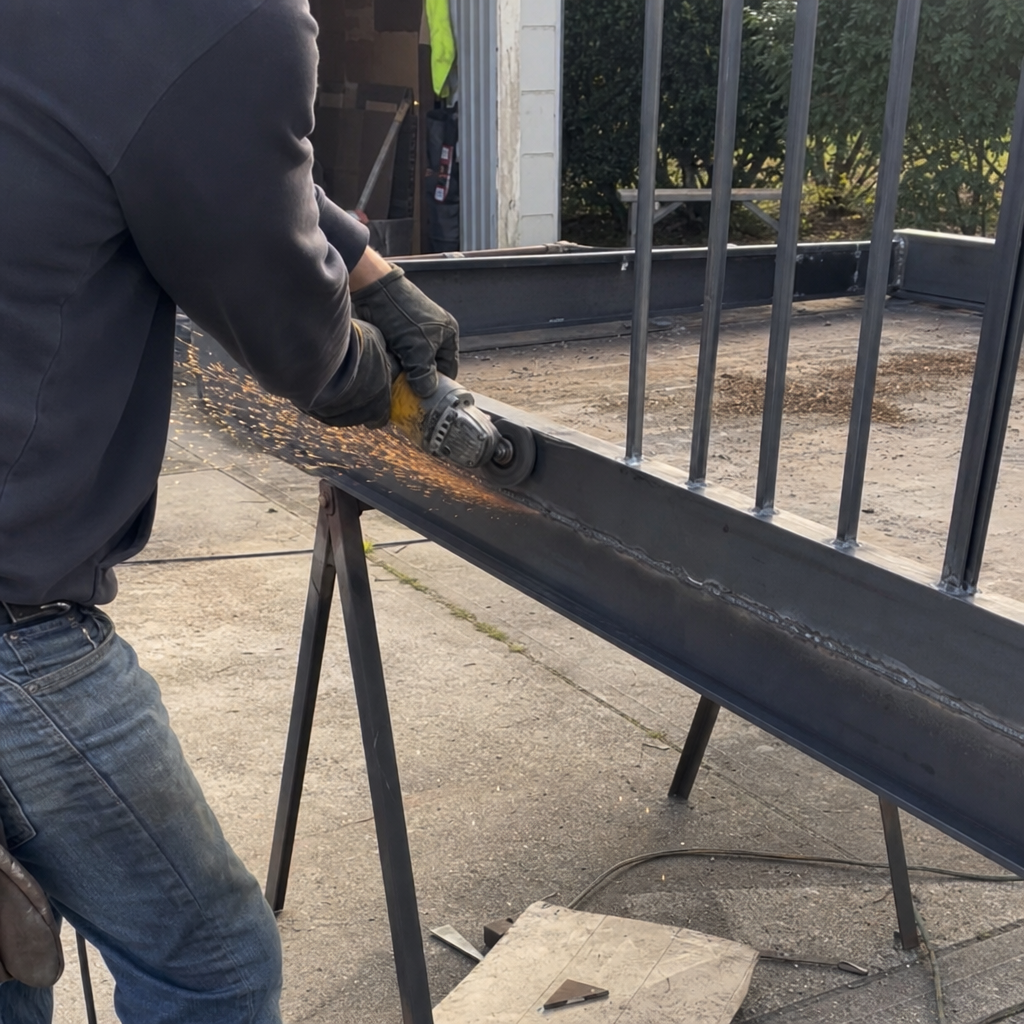
Welding on a loaded gate frame involves forces that can shift suddenly when you cut a bad weld free. Cutting torches, grinders, and arc welders around gate automation electronics risk fire and board damage. And the structural math matters: a bracket that looks right but is under-specced for the gate’s weight and wind load will fail, sometimes with the gate falling on a vehicle or person. We’ve been called to clean up after well-meaning repairs in New York City that left the gate less safe than when it started.
If you’re not certain what you’re looking at, call (877) 326-7055. A live person answers, day or night, and we’ll tell you straight whether this is a quick adjustment or a fabrication job.
FAQs
A properly fabricated and coated weldment should last 15-20 years, but we’ve seen DIY and cut-rate jobs fail in 3-5 years because the weld wasn’t sealed against salt, road spray, and freeze-thaw. In coastal zones like the Rockaways or areas with heavy sidewalk salt in winter, annual inspection of the coating pays for itself. Call (877) 326-7055 to schedule an $89 seasonal tune-up.
Small cracks in non-structural brackets can sometimes be ground out and re-welded if the metal around them is sound. Load-bearing hinge plates, actuator mounts, and track supports almost always need replacement; a repair in high-stress steel is a crack waiting to restart. We assess this on site and tell you which path is the square deal. Free estimates, no obligation.
Most bracket and track jobs are completed in two to four hours, start to finish, with the gate operational when we leave. Larger frame rebuilds or jobs requiring custom cutting may run into a second day, but we quote that upfront. Same-day service is standard for stocked parts in Manhattan, Brooklyn, Queens, and the Bronx.
We stock common LiftMaster-compatible brackets, hinge assemblies, track sections, and hardware in standard sizes, along with our mobile welding rig and cutting equipment. Oddball commercial specs or gates with non-standard dimensions get fabricated in our shop and installed next business day. Call (877) 326-7055 and we’ll confirm whether your part is on the truck or needs a shop day.
Written by Frank Delmonico, Owner, Ironworks Gate Co. of New York City at Ironworks Gate Co. of New York City, serving New York City and nearby areas.