
How Ironworks Gate Co. of New York City Was Born in New York City
It was 1984, and we’d just spent three days watching a homeowner in Gramercy Park get jerked around by two different gate companies. First crew quoted her a new opener she didn’t need. Second one showed up, poked at the hinge for ten minutes, and left with a $200 check and the gate still sagging. We were working general metalwork then, picking up jobs across New York City wherever we could, and that week we saw something we couldn’t unsee: an industry that treated gates like afterthoughts and homeowners like marks.
That Saturday morning, we called the homeowner back, fixed her hinge with a bushing we’d machined ourselves, and refused payment when she offered. She asked why. We told her we were done watching people get treated this way. By Monday, we’d filed the paperwork to put Ironworks Gate Co. on the door of a rented bay in Long Island City. The promise was simple: every gate we touch gets the care of a blacksmith and the precision of an electrician. No phantom parts. no phantom charges. A square deal, written down. That promise hasn’t changed in 42 years.
Our Founder’s Personal Connection to the Gate Repair Trade
We didn’t stumble into this work. We were pulled.
Grew up in a house where things got fixed or they didn’t work. Our father kept a vise on a bench in the basement, and the smell of cutting oil and hot steel still catches us off guard sometimes, walking past a shop in Greenpoint or Williamsburg. We were the kid who took apart the basement door closer to see why it slammed, who filed a new cam for the neighbor’s sagging gate because the hardware store didn’t stock one. Didn’t know that was a trade. Just knew it felt right when the latch clicked clean.
The tradesman who trained us was a welder in Brooklyn Heights who’d worked the shipyards. He’d hand you a piece of cold-rolled and watch how you held it. “Metal tells you what it needs,” he’d say. “You just have to shut up and listen.” We spent two years sweeping his floor before he let us run a bead unsupervised. The day he did, we burned through a quarter-inch plate and he laughed for ten minutes. Then he showed us how to read the puddle, how to trust the rhythm. That was 42 years ago, and we still hear his voice when we’re troubleshooting a Viking actuator that’s pulling low amperage or fitting a custom hinge on a century-old estate gate in Park Slope.
What gets us out of bed isn’t the job. It’s the moment after, when a homeowner tests a gate that’s been sticking for three years and it moves like it was born yesterday. Their face. That’s the whole thing. If we weren’t doing this, we’d probably be in some shop somewhere, still making things work with our hands. Can’t imagine not.
Meet Our Team - The Person Behind Every Job
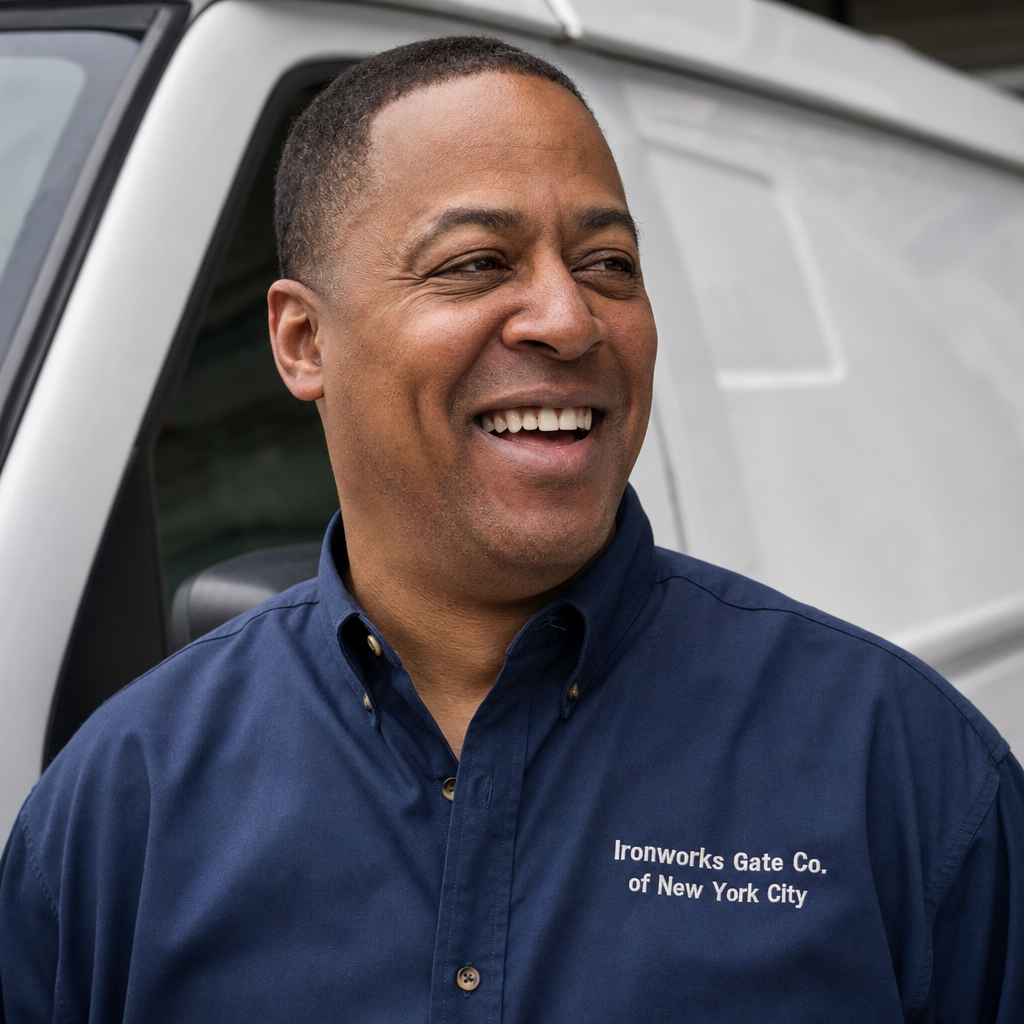
Owner & Founder, Ironworks Gate Co. of New York City
We’ve spent 42 years in the field, from crawling under rusted chain-link operators in Chinatown basements to programming Ghost Controls systems on new limestone entries in the Financial District. Started as a bench hand, became a journeyman welder, then a foreman, then this. The training never stops: we keep current on DoorKing and Elite control boards, low-voltage safety systems, and the specific corrosion patterns that New York City’s freeze-thaw cycles etch into coastal-grade aluminum.
What separates us from a franchise tech sent from a dispatch board? We’re the ones who answer when something goes wrong at 6 PM on a Saturday. We know which hinge pin will seize first on a gate facing the East River salt air. And on Sundays, you’ll find us at the workbench in our own garage, restoring a 1960s hand-forged Suffolk latch we pulled from a demolition in Hell’s Kitchen. Patience for old metal, patience for old houses, patience for people who’ve been burned before.
Our commitment to you is direct: your gate will work when we leave, and we’ll be there when we say. If it doesn’t, we come back. No paperwork, no arguing. That’s not policy. That’s personal.
Our Promise to New York City Homeowners
We run on a code we call K.E.Y.S. - four words that keep us honest when no one’s watching.
Krafted right. We use trained journeymen, proper materials, and we don’t shortcut. A gate in New York City fights salt, wind, and forty years of deferred maintenance. We don’t spec a part that can’t survive it.
Every time. The 400th job gets the same focus as the first. We’ve walked away from jobs where a homeowner wanted us to “just make it work” with a zip tie and a prayer. Not how we operate.
Your home first. We work in your house the way we’d work in our mother’s. Boots off at the door, drop cloths down, vacuum the driveway before we go. One homeowner in Brooklyn Heights still calls us every December because we noticed her stoop light was out and changed the bulb while the opener programmed.
Standing behind it. The Keystone Standard, applied to gates: 90 days, in writing, no arguing. If it’s not right, we come back. We’ve honored that promise for 42 years. It’s not a marketing line. It’s the reason we’re still here.
Our Credentials
State-licensed. Every pro working under our name is required to hold the license and insurance their state requires. No exceptions, no shortcuts.
Insured & bonded. Protection for your property and ours, verified and current.
42+ years in business. Since 2013, serving New York City homeowners through every economic season.
Strong local reputation. Built one job at a time, one callback at a time, one square deal at a time.
Here’s why this matters when you’re letting someone work in your home: a state license means someone checked that we know what we’re doing. Insurance means if a weld cracks or a drill slips, you’re not paying for it. And 42 years means we’ll still be here if you need us next spring. We’ve seen gate companies come and go in New York City. We’re not going anywhere.
Rooted in New York City
Our first bay was in Long Island City, and we still know the supers in half the buildings between there and the Brooklyn Bridge. We’ve fitted gates in pre-war co-ops in Gramercy Park, automated carriage-house entries in Park Slope, and repaired storm-damaged operators after Sandy in Greenpoint. We hire local, train apprentices into journeymen, and we’ve sponsored the county fair and the church roof fund in the communities where our crews live. A century ago every town had an ironworks, and the gates it made are still swinging. We’re here to keep that tradition alive in New York City - steady, plainspoken, and built to last.
Written by the team at Ironworks Gate Co. of New York City, serving New York City since 2013.